




What Is Mandrel Bending? A Complete Guide
What Is Mandrel Bending? A Complete Guide
Mandrel bending is a rotary draw bending process that pulls a flexible internal support — the mandrel — through the tube while the tube is bent, keeping the bore open so the wall does not collapse. It is the method used when a bend has to stay round, hold wall thickness on the outside radius, and look clean enough to go straight into a welded assembly. This guide covers how the process works, where it wins and where it costs too much, and what to specify on a drawing so the part comes back right the first time.
How mandrel bending works?
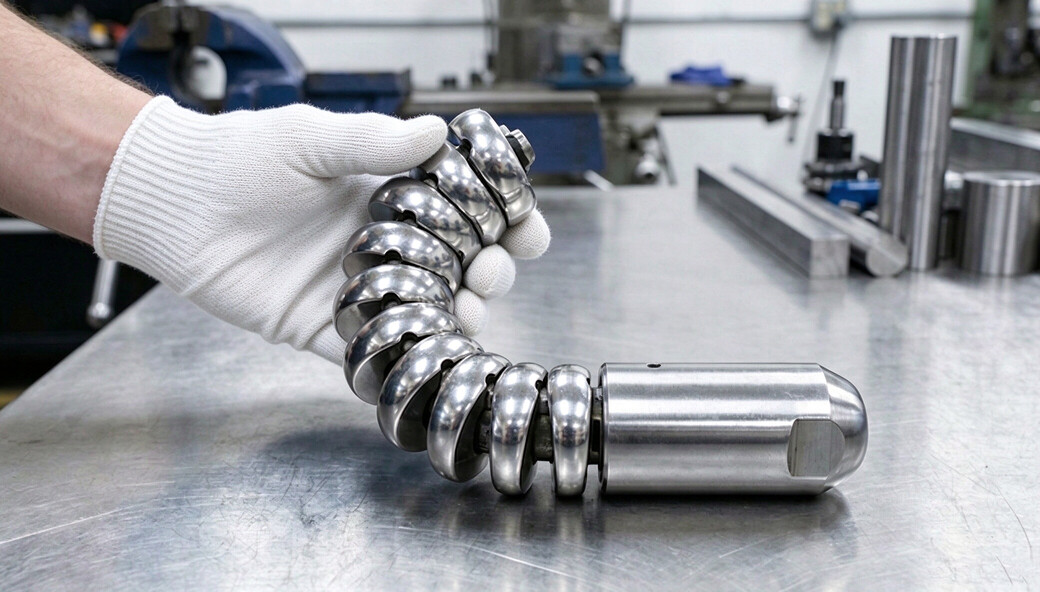
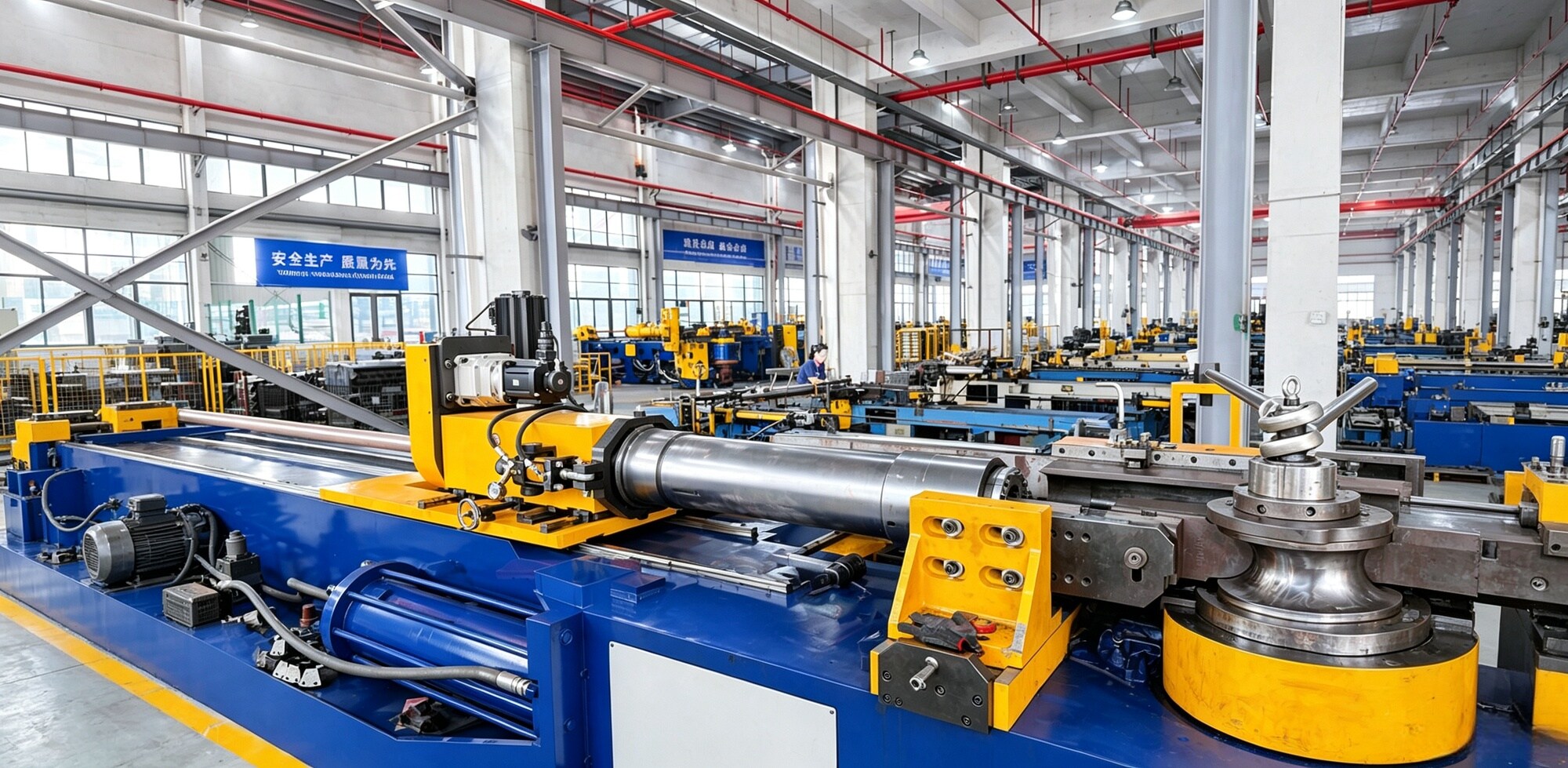
The tube is clamped in a bend die, a wiper die sits behind the tangent point, and a mandrel — a hardened steel rod with 2 to 5 linked balls on the end — is positioned inside the tube so its nose sits at the start of the bend. As the bend die rotates and the tube is drawn forward, a pressure die holds the outside wall against the die, the wiper die blocks material from bunching ahead of the bend, and the mandrel balls support the inside wall through the arc.
Five tooling elements do the work, and each one controls a different failure mode.
| Tooling element | What it does | Failure if set wrong |
|---|---|---|
| Bend die | Sets the centerline radius (CLR) | Wrong radius, out-of-tolerance leg length |
| Clamp die | Holds the tube during draw | Tube slips, end scrap, inconsistent angle |
| Pressure die | Pushes the outside wall into the die | Wrinkles on the inside radius, ovality |
| Wiper die | Scrapes material back from the bend line | Wrinkles and thickening ahead of the arc |
| Mandrel (rod + balls) | Supports the inside wall through the arc | Collapse, flattening, wall thinning |
A bend is defined by three numbers: outside diameter (OD), wall thickness (WT), and centerline radius (CLR). The ratio of CLR to OD, usually written as R/D, is what decides whether a mandrel is needed at all.
Mandrel bending vs. other bending methods
| Method | Tooling | Best for | Typical limits |
|---|---|---|---|
| Mandrel (rotary draw) | Mandrel + bend die + wiper | Tight radius, thin wall, cosmetic or welded parts | R/D roughly 1.5 and below, up to ~2.0D depending on wall |
| Rotary draw without mandrel | Bend die + wiper only | Moderate radius, heavier wall | Wrinkling and ovality rise as radius tightens |
| Press / ram bending | Form block, no internal support | Large radius, low volume, structural pipe | Ovality visible; not for tight work |
| Roll bending | Three rolls | Wide sweeps, architectural curves | No fixed radius per bend |
| Heat induction bending | Induction coil + water quench | Large pipe, heavy wall, long radius | Higher setup cost, heat-affected zone |
Rule of thumb buyers can use: below about R/D = 1.5 on a thin wall, expect a mandrel. Above roughly R/D = 3, a wiper die alone often holds tolerance. Between the two, the wall thickness ratio decides.
Key parameters that decide the result
Four numbers on the drawing drive tooling, price, and scrap rate. If the drawing does not state them, the shop will guess — and one guess costs a rebuild.
| Parameter | What it means | Why it matters |
|---|---|---|
| Outside diameter (OD) | Tube size | Sets the die and mandrel size |
| Wall thickness (WT) | Wall before bending | Thinner wall bends easier but collapses sooner |
| Centerline radius (CLR) | Radius measured to tube centerline | Drives the R/D ratio and whether a mandrel is required |
| Bend angle | Degrees of arc | Sets machine stroke and springback allowance |
| Leg length | Straight length before and after the bend | Too short and the clamp cannot hold the tube |
| Bend plane and rotation | Orientation between bends | Errors here show up as a part that will not fit the fixture |
Four defects account for most rejected bent tubes. Ovality is the cross-section going out of round on the bend; it is measured as the difference between the largest and smallest diameter, divided by the nominal OD. Wall thinning is the outside radius stretching, so the wall there gets thinner than the original. Wrinkling is material bunching on the inside radius, and it usually traces back to pressure die force or mandrel position. Springback is the tube opening up slightly after the tooling releases, which is why bend angle has to be over-bent and compensated.
For precise fit-up and smooth tube routing, Ningbo Pino Metal offers custom mandrel bends in stainless steel, carbon steel, aluminum, and other materials.
Where mandrel bending is used in exhaust and truck parts?
Mandrel bending earns its cost in three situations: the bend must stay round, the part must be welded downstream, or the bend has to flow well.
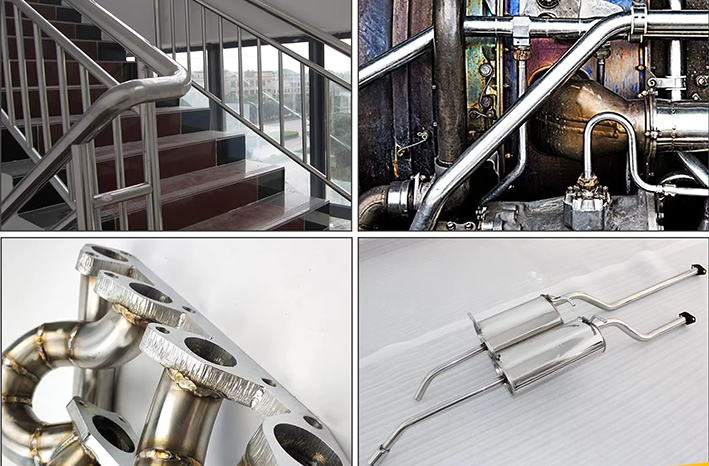
· Exhaust and tailpipe sections. A bend that flattens costs flow and creates a hot spot. Mandrel bending keeps the cross-section open through the arc.
· Stacks and vertical exhaust. Cosmetic surfaces show every wrinkle, so the inside radius has to stay smooth.
· Charge air and intake tubing. Thin-wall aluminum and stainless need internal support or the tube ovalizes at the bend.
· Deer guards and tube-based guards. Visible tube work where a collapsed bend is a visible defect on the vehicle.
· Manifolds, headers, and collectors. Multi-bend parts where one flat bend throws off the fit-up downstream.
Materials behave differently, and the shop needs the grade before quoting tooling.
| Material | Behavior in mandrel bending | Practical note |
|---|---|---|
| Mild / carbon steel | Predictable, wide tolerance window | Lower tool wear, cheapest to bend |
| Aluminized steel | Coatings can crack at the outside radius | Bend direction and coating side matter |
| Stainless steel | Higher springback, work hardening | More compensation passes, tighter mandrel clearance |
| Aluminum | Low springback, prone to galling | Mandrel lubrication and surface finish decide quality |
| Titanium | Springback and galling, tight tolerance window | Slow cycle, high tooling wear |
What changes cost and lead time?
Four inputs move the price more than anything else: R/D ratio, wall thickness, number of bends per part, and annual volume. A part with a tight radius and three bends needs more tooling than the same part with one gentle bend.
| Input | Lower cost direction | Higher cost direction |
|---|---|---|
| R/D ratio | Open radius, no mandrel | Tight radius, mandrel plus wiper |
| Wall thickness | Standard stock wall | Non-standard or heavy wall |
| Bends per part | One or two | Four or more with rotation |
| Volume | Repeat annual orders | One-off or prototype runs |
| Material | Carbon steel | Stainless, aluminum, titanium |
| Tolerance | Dimensional per drawing | CMM-verified, FAI report required, etc. |
Cautions: where mandrel bending is the wrong choice
- Very large radius bends. Above roughly R/D = 3, a wiper die or a roll-bent sweep does the job for less money.
- Very thick wall relative to OD. The mandrel adds nothing when the wall can carry the bend on its own.
- Square, rectangular, or oval tube. Round mandrels do not apply; a different process is needed.
- Very short legs. If the straight section is too short to clamp, the bend cannot be drawn, no matter the tooling.
- Deeply limited budget on a non-cosmetic part. If nobody will see the bend and nothing welds to it, decide whether roundness actually matters before paying for it.
What to put on a bending drawing?
A drawing that quotes cleanly has six things on it. Missing any one of them turns into a question, a delay, or a scrap part.
1. OD, wall thickness, and material grade with the governing standard — or [TO CONFIRM: standard number] if the grade is given by the customer.
2. CLR for every bend, plus bend angle, and the direction of each bend in the same plane or rotated.
3. Straight leg lengths between bends, measured to tangent points or intersection points — state which.
4. End treatment: cut square, deburred, flared, reduced, or welded.
5. Inspection requirements: which dimensions are checked, ovality limit, wall thickness check, and whether an FAI report or material test report is needed.
6. Surface and packaging requirements, especially for coated or polished tube.
Note: A 3D model or STEP file removes most of the ambiguity, but the drawing still has to carry the tolerances.
FAQ
What is the difference between mandrel bending and normal tube bending? Normal rotary draw bending uses a bend die and a wiper die only. Mandrel bending adds an internal support — a rod with linked balls — that holds the tube wall open through the arc. The result is a bend that stays round with less wall thinning, which is why it is used for thin-wall, tight-radius, and welded parts.
What is the minimum bend radius for mandrel bending? It depends on wall thickness. A common working range for round tube is around 1.0 D centerline radius with a mandrel, and down to about 0.5 D on heavy wall with special tooling. Your actual limit is set by OD, wall, material, and the ovality you can accept, so confirm it against a real drawing.
Does mandrel bending thin the tube wall? Yes. The outside radius stretches, so the wall there gets thinner than the nominal wall. The mandrel limits that thinning by supporting the inside wall, but it does not remove it. State the minimum retained wall on the drawing so the shop can choose tooling and a starting wall to meet it.
Which materials can be mandrel bent? Carbon steel, aluminized steel, stainless steel, aluminum, and titanium are all commonly mandrel bent. Copper and some nickel alloys are also bendable. The material grade changes springback, tooling clearance, and lubrication, so give the grade rather than just "steel" when you request a quote.
Can mandrel bending handle multiple bends in one part? Yes. Rotary draw machines index and rotate the tube between bends, so parts with several bends in different planes are routine. The limit is usually leg length — each bend needs enough straight section to clamp and to clear the tooling.
Send your drawing for a quote!
Send the tube OD, wall thickness, material, bend radii, and a STEP or DXF file to Brian@cnpinometal.com, and we will return a quote with tooling status and lead time.